Is Your Kid Ready for a Phone? Five Things That Matter More Than Their Age
Your kid has asked for a phone again. Maybe it’s the third time this month. Maybe they’ve started listing the friends who already have one. So you search for the right age to give a kid a phone, and you get answers anywhere from 10 to 16, each one stated with total confidence.
Age turns out to be very little help. Two eleven-year-olds can handle a phone completely differently. One will put it down when dinner starts and tell you the minute a group chat gets ugly. The other will be scrolling under the covers at midnight by the second week, and you won’t hear about the group chat until another parent calls.
A better way to decide is to look at what a phone will ask your kid to do, and then check whether they’re already doing those things somewhere else. You’ve been watching them for years. You already know most of the answers.
Here are the five things I’d look at.
1. Can they stop on their own?
If you only look at one thing, look at this one.
A phone has to be put down dozens of times a day: at dinner, at bedtime, when homework starts, when a friend is talking to them. Most of those times you won’t be in the room to say so. Apps are built to make stopping hard, so a kid who already struggles to stop will find it harder.
You can see how your kid does with this right now. Think about the last few times screen time ended on the tablet, the TV, or the game console. Did they stop when time was up, or did it turn into an argument? Have they ever stopped on their own, before anyone said anything?
If this is hard for them, practice it on a device you control. Agree on a stop time together, then let them be the one to turn it off. A tablet or a console is a good place to learn this because you can pause and nothing is lost.
2. Do they tell you when something goes wrong?
At some point something will go wrong on the phone. A mean message, a video they shouldn’t have seen, a stranger who seems friendly, a group chat that turns on someone. That’s going to happen to almost every kid with a phone, so whether it happens matters less than whether you hear about it.
Kids who tell a parent early get help early. Kids who hide it end up dealing with it alone, and it usually gets worse before anyone finds out.
Think about the last time your kid broke something, got in trouble at school, or did something they were embarrassed about. Did you hear it from them, or from someone else?
If it’s usually someone else, pay attention to how you react the next time they own up to something small. If they get a calm conversation, they’re more likely to come to you when something bigger happens. If they get a lecture and a punishment, they’ll learn to keep things to themselves.
3. Are bedtime and routines already steady?
Sleep is usually the first thing a phone costs a family. If bedtime is already a fight most nights, a phone will make it a harder fight.
Look at how evenings go now. Does your kid get to bed close to the right time without a nightly battle? Does homework get done before entertainment without you standing over them? Do mornings run without screens getting in the way?
If evenings are rough, work on bedtime first. And decide now where the phone will charge overnight, somewhere outside their bedroom. It’s much easier to start with that rule than to bring it in later.
4. How do they handle friendship trouble in person?
Group chats move fast. They go on late at night, and the whole class can see what gets said. A kid who gets left out at recess might feel bad for an afternoon. A kid who gets left out of a group chat can watch it happen in real time, at 10pm, from their bed.
The way your kid handles friendship problems in person is a good guide to how they’ll handle them on a phone. When they get teased or left out, does it ruin the whole day, or do they bounce back? Do they talk to you about it? Can they let an argument go without needing the last word?
Nobody expects a ten-year-old to be good at this. What you want to see is that they recover and that they talk about it. If you’re not sure, ask them about the last time a friendship went wrong and what they did. A kid who can tell you what happened has a better chance of spotting the same thing when it happens in a group chat.
5. Do they look after their things and keep small promises?
A phone is expensive and comes with rules. This is the easiest of the five to answer honestly, because you’ve already watched how they handle other things.
Do they keep track of their own belongings, or do jackets and water bottles disappear every month? Do they keep small promises without being reminded? Do they follow a rule when you’re not there to check?
This one gets better with practice more than with age. Give them something smaller to look after first, like a watch or a key to the house, and let them deal with what happens if it gets lost.
If the answer is “not yet”
“Not yet” doesn’t mean the answer will always be no. Every one of these five things can be practiced, and most kids improve at them quickly once someone is paying attention. Pick the weakest area, work on it for a few months, and look again.
If the real reason for a phone is that you need to reach them, on the walk home or after practice, that’s a separate problem from whether they’re ready for a smartphone. A basic phone or a watch that only calls and texts can cover it while they work on the rest.
And if “everyone else has one” is the part weighing on you, it’s a fair worry. Being the last kid without a phone has a real social cost. But a kid who gets a phone before they can stop on their own, or before they’ll tell you when something goes wrong, will have a harder time than a kid who waited a few months.
A quick way to check
I turned these five areas into a free check called The Phone Readiness Check. It’s fifteen questions and takes about four minutes. None of the questions ask how old your kid is. At the end you get a straight answer (ready, nearly, or not yet), which area is strongest, which area is weakest, and one specific thing to work on first.
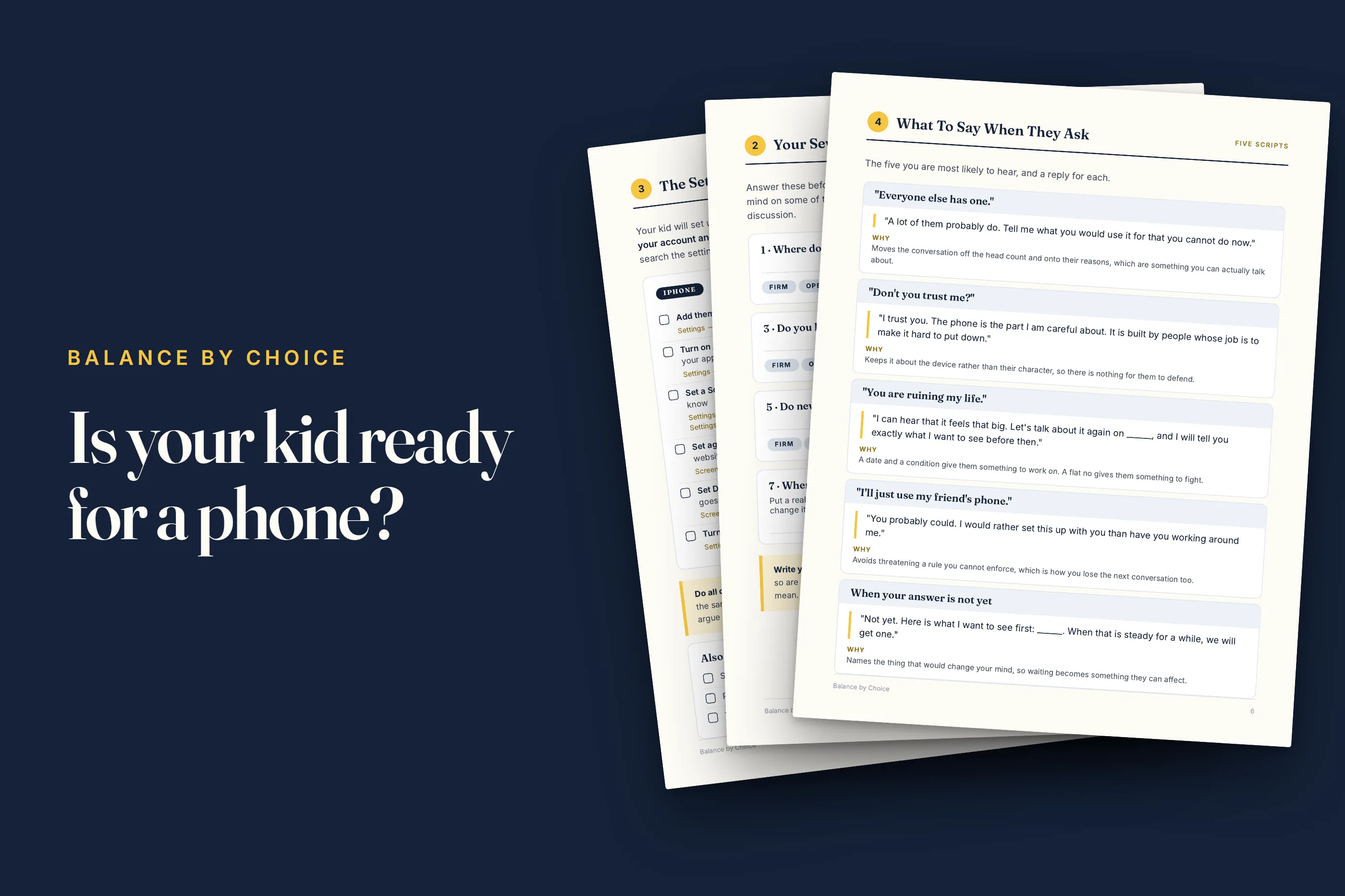
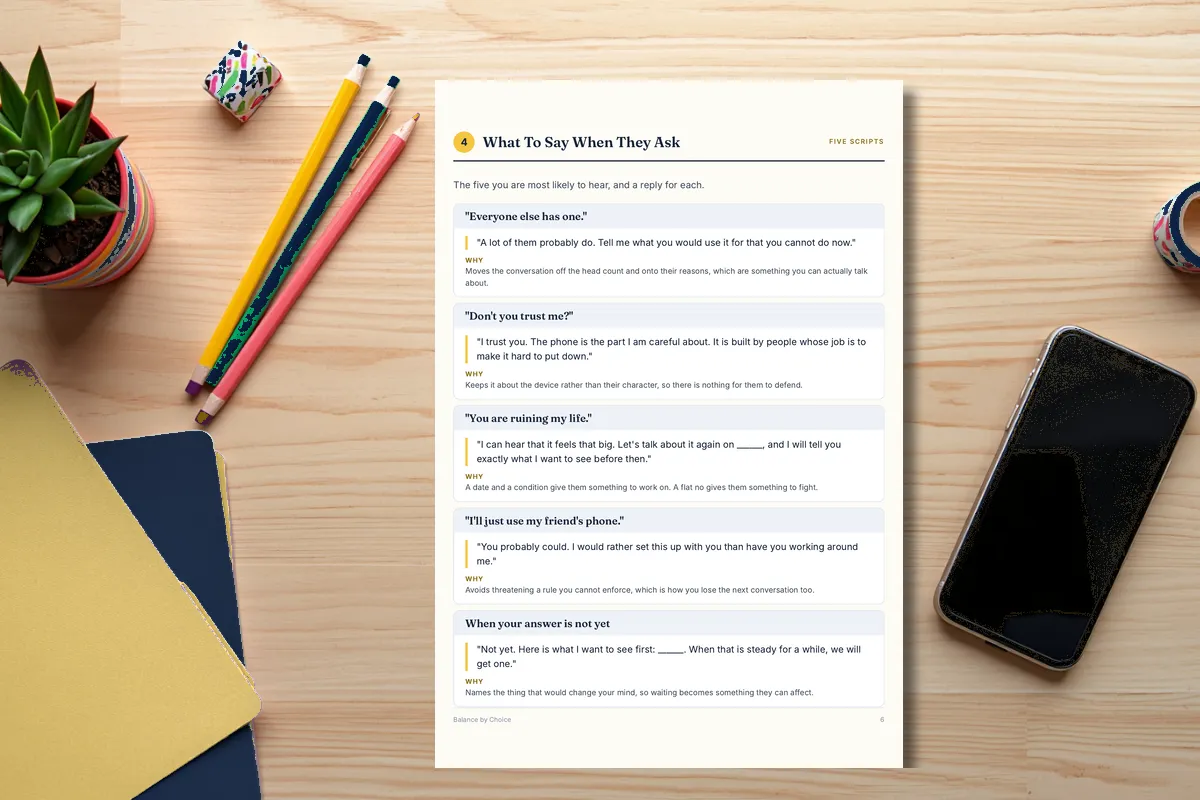
If you’d like it, you can also get my free parent kit, Before the First Phone, at the end of the check. It covers the seven decisions to make before you hand a phone over, the setup only a parent can do, five scripts for when your kid asks, and what to say when something goes wrong.
Take the Phone Readiness Check here.
When you’re ready to hand it over
Once you’ve decided your kid is ready, the first few weeks matter a lot. The habits they build in that first month tend to stick.

That’s why I wrote Your First Phone: A Kid’s Guide to Healthy Habits, a guidebook for kids ages 10 to 14. It’s written to the kid, so they learn how apps are designed to hook them before it happens, and they set up their own notifications, privacy settings, time limits, and phone-free zones over 30 days. Every chapter has a Parent Corner with questions to ask when you sit down together.
You can check it out on Amazon here.
You don’t need to find the perfect age. You need to know whether your kid can stop on their own, whether they’ll tell you when something goes wrong, and whether the rest of their day is steady enough to handle a phone. You can answer most of that tonight from what you’ve already seen.