What Your Kid Is Actually Hearing When You Talk About Screens
You’ve had this conversation before. You sat your kid down to talk about screen time, the conversation went okay, you felt like things were settled. Then a week later you realized nothing had actually changed. Same phone use, same arguments, same blank-eyed nods every time you tried to bring it up again.
Your kid isn’t being defiant, and they aren’t tuning out because they don’t care. What they heard you say is different from what you said.
The empathy gap between parents and kids about screens is bigger than many parents realize. You say one thing, and your kid hears a different thing entirely. The conversation continues with both of you thinking you’re talking about the same topic and both of you walking away with completely different understandings of what happened.
Closing that gap is the difference between conversations that build something over time and conversations that produce a polite nod and then nothing.
Here are five things to know about how your kid is actually receiving what you say.
1. Lecture mode is invisible to you and unmistakable to your kid
Almost every parent who has had multiple screen time conversations with their kid has, at some point, slipped into lecture mode without realizing it. You hear yourself starting with a phrase like “I just want you to understand…” or “The thing is…” and the next few minutes are you delivering points in a row, fueled by genuine concern, with very little space for your kid to respond.
From your side, this feels like clear communication. You’re explaining the situation patiently and thoroughly.
From their side, this is a lecture. The signal that triggers the shift is the moment you start using complete paragraphs instead of complete sentences. When you say one thing and then keep going, your kid checks out. They’ve shifted from “my parent is in conversation with me” to “my parent is monologuing at me, and my only job is to wait for it to end.”
The fix is shorter turns. Aim for about two sentences from you, then a pause, then a question. Your kid might not respond right away. Wait anyway, because the pause itself is what turns this into a conversation rather than a monologue.
2. The opening sentence determines whether they listen at all
A kid who hears “We need to talk about your screen time” has, in the first six words, already concluded that they’re in trouble. The rest of the conversation, however well-intentioned, gets received as a verdict being delivered, not a discussion being started.
Compare those opening words with:
- “Hey, I read something kind of interesting today about how apps work. Have you noticed…”
- “Random question: do you know what an algorithm is?”
- “I was thinking about something I saw on your phone. Can I ask you about it?”
Same parent talking to the same kid about the same general topic, but completely different receiving conditions.
The opening sentence sets the frame for what follows. A frame that suggests “lecture incoming” triggers a defensive response before you’ve said your second sentence. A frame that suggests “I’m curious about something” lets your kid lean in instead.
3. What you say is filtered through what they think you mean
Even when you’re not lecturing, even when you open well, your kid is interpreting your words through a filter you don’t see. The filter is built from previous conversations, current mood, what their friends have been saying, and whatever insecurity they brought into the room.
You might say “I’m noticing that screen time has been creeping up lately.” Depending on the filter, your kid hears one of several different sentences:
- A kid who feels generally good about your relationship hears: “Mom or Dad has been paying attention to me and is bringing this up because they care.”
- A kid who’s been feeling criticized hears: “Here we go again. They’re going to take my phone away.”
- A kid who’s been thinking about their own phone use hears: “They see what I see. Maybe it’s not just me.”
The same words landing in different filters produce completely different conversations.
You don’t get to control your kid’s filter directly. What you can do is read the early signals of which filter you’re working against. A defensive response usually means they took your opening as criticism. Genuine curiosity usually means they took it as care. An eye roll usually means they heard a lecture coming. The first thirty seconds of a conversation tell you which version you’re actually in, and you can adjust from there.
4. Questions land better than statements (when the questions are real)
A statement tends to close a conversation. A question can open one, but only if the question is real. A pretend question shuts down the conversation faster than a statement would have.
The difference between a real question and a pretend question is whether the asker is genuinely interested in the answer. “Don’t you think you’ve been on your phone too much?” is not a question. It is a statement dressed up as a question, and your kid hears the costume immediately.
Real questions sound like:
- “What do you think your friends would say is too much phone time?”
- “How do you feel after a long scroll session, honestly?”
- “If you were in charge of designing the perfect day for yourself, how much screen time would you actually want?”
These questions have answers you cannot predict in advance. That’s the test. If you already know what you want them to say, the question isn’t real, and your kid figures that out within the first few words.
A kid asked a real question by a parent who actually wants to know the answer will, more often than not, give a real answer. A fake question gets a fake answer back, or no answer at all.

5. The conversations that matter often happen sideways
The setup of “we are sitting across from each other and now we are going to talk about an important topic” almost guarantees the topic gets received as a confrontation. For kids in this age range, being looked at directly during a hard conversation is more pressure than they can handle without going defensive.
Sideways conversations work better. By “sideways” I mean conversations where you and your kid are doing something else together: driving, cooking, walking the dog, playing a game, doing dishes. Your eyes are on the road or the bowl or the path. The topic comes up incidentally rather than formally.
There is something specific about not looking at each other that makes hard topics easier to talk about for kids this age. The pressure of being observed while answering is removed. They have room to think while they answer, and they can offer something tentative and then revise it without feeling like they’re being graded.
A lot of the best conversations parents have with their kids about screens never start with a parent intending to have a conversation. They start with a moment of shared activity and a casual question. The conversation happens because the conditions allowed for it.
When you want a guide to the conversations themselves
The five things above are about the mechanics of being heard. Knowing how your kid is actually receiving what you say is the foundation. What you say across the seven or eight topics that matter most between ages 8 and 12 is the work itself.
That’s why I wrote Because They Want To: Raising Kids Who Choose Screen Balance for Themselves, a parent’s guide to the conversations that build a kid who can think clearly about their own digital life.
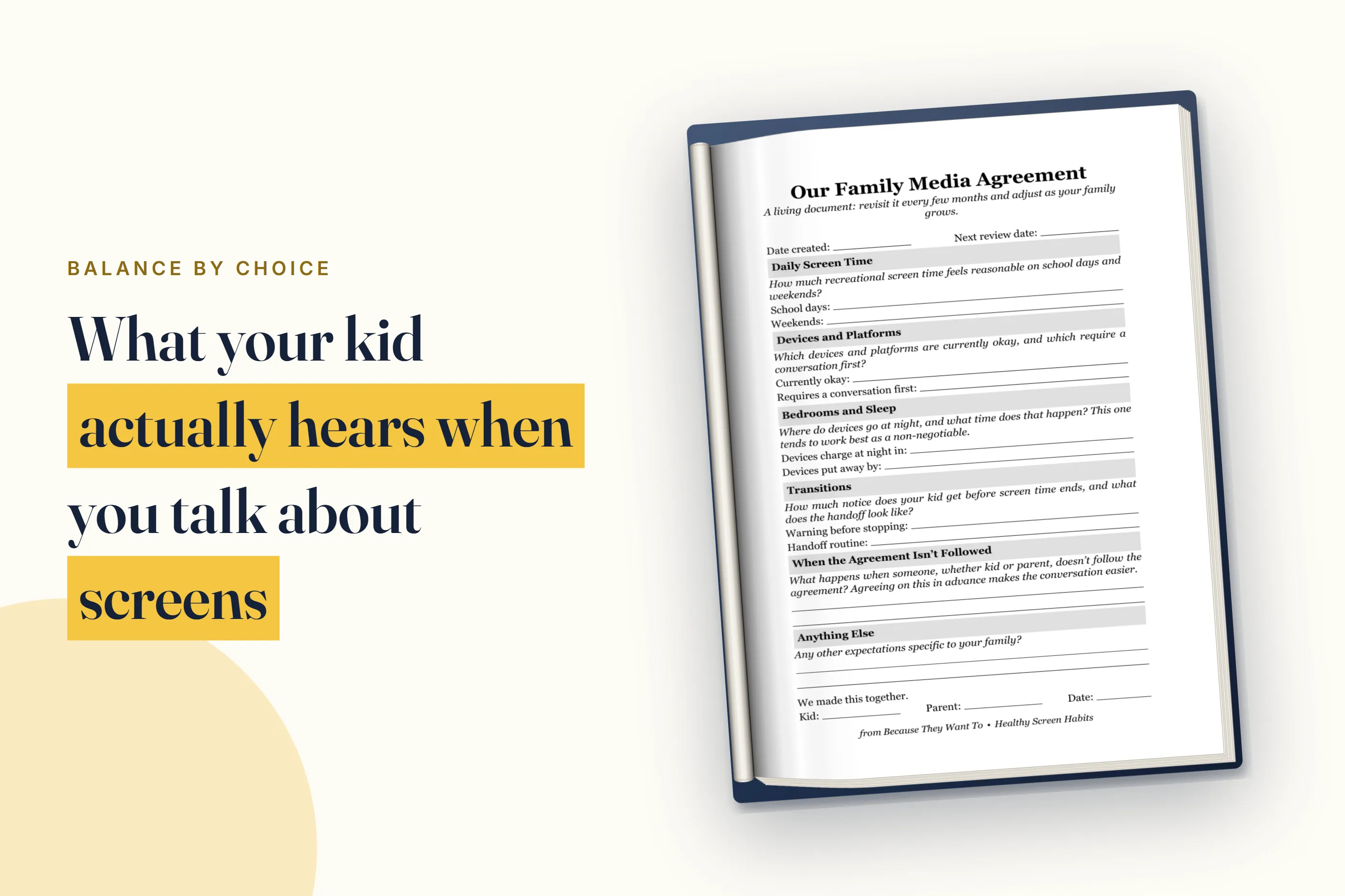
Each chapter is organized around a single big topic: screen time and balance, first phones, social media, gaming, AI and chatbots, sleep, and online friendships and safety. Every chapter includes a section called Through Their Eyes that takes your kid’s perspective seriously, because the whole methodology rests on understanding what your kid is actually hearing when you raise these topics. The book also has conversation starters you can use in your own voice, examples of what these conversations sound like in practice, and a Quick Reference section at the back with conversation cards, a Family Media Agreement template, and a Warning Signs guide.
You can check it out on Amazon here.
· · ·
Much of the work of digital parenting is about saying things in a way your kid can actually hear. That means watching for the lecture mode, opening with curiosity, asking questions that are real, and having the harder conversations sideways instead of face to face. None of these moves has to be perfect; they just have to be received. Over time, kids who feel heard tend to develop the capacity to think about screens on their own, and that capacity is what you are actually building.