Why "Just One More Game" Is So Hard to Stop
You give the ten-minute warning. Ten minutes later you come back, and they’re still playing. You say it’s time, and they say they can’t stop now, they’re in the middle of a match. By the time the console is off, everyone is upset.
It’s easy to read that as your kid ignoring you. Most of the time something else is going on. The game they’re playing was designed by a team of people whose job is to keep players playing, and they’re very good at it. An eight-year-old who struggles to stop is up against all of that work.
Once you can see how a game keeps a kid playing, the end of gaming time gets easier to plan for. Here are the tricks that make stopping hardest, and what to do about each one.
1. There’s no natural place to stop
A book has chapters. A TV show ends after 22 minutes. Many video games never give you a place to stop at all. One match ends, and the next one starts in five seconds unless you do something. Some games have no end at all. You can build, explore, or farm forever.
When a game doesn’t end, the kid has to decide to stop in the middle of something they’re enjoying. That’s hard for adults. For kids, whose ability to stop themselves is still developing, it’s harder.
What helps: Talk about stopping points before the game starts, not when time is up. Ask your kid where a good place to stop would be in the game they’re playing. The end of a match? After they save? When they get back to the main menu? Then end gaming time at one of those points instead of at an exact minute.
2. Other people are counting on them
In a team game, leaving in the middle of a match lets the other players down. Some games even punish players who leave early. When you say “turn it off now,” your kid isn’t only thinking about the game. They’re thinking about their friends, or their team, who are about to be one player short.
What helps: Give your kid a way to tell the other players they’re leaving. Agree that when the warning comes, they tell their squad “last game,” and then they finish that one match and log off. Kids are much more willing to stop when they don’t have to leave their friends hanging.
3. The game rewards them for coming back
Daily login rewards, streaks, and limited-time events all send the same message: if you don’t play today, you’ll miss something. A kid with a 40-day streak doesn’t want to lose it. A kid who knows the event ends Sunday feels pressure to play as much as possible before then.
What helps: Name it out loud, without making fun of it. “That streak is there to make you feel like you have to log in every day. Do you actually want to play today, or does it just feel like you have to?” Kids get noticeably less upset about losing a streak once they understand what the streak is for.
4. “I almost won”
Losing by a little feels very different from losing by a lot. A close loss makes the next game feel like the one you’ll win, and games are designed to give players lots of close calls. A kid who almost won is the kid who begs hardest for one more try.
What helps: Watch for the pattern. If the arguments are worst after a close loss, plan the stop time around it. A kid who says “I’ll stop after I win one” can end up playing for an hour. “One more match, win or lose” is a deal they can keep.
5. Getting rewarded for leveling up
New skins, new levels, new items. Games hand out rewards on purpose, with the next one always just out of reach. “I just need a few more points to unlock it” is a very common reason a kid wants five more minutes.
What helps: Ask your kid how close they are, and believe them. If they’re two minutes from something they’ve been working toward, letting them finish can be a reasonable choice. The thing to watch is whether there’s always one more thing to unlock. There usually is, because that’s how the game was designed.
Why understanding beats a timer
You can set a timer and enforce it every night. Lots of families do. But a timer only works while you’re there to enforce it. It doesn’t teach your kid anything about why they find it so hard to stop.
A kid who can spot these tricks for themselves (“this streak is just trying to make me log in,” “the next game starts automatically, so I need to decide now”) has a much better chance of stopping on their own. That’s the skill that will still matter when they’re 13 and gaming in their bedroom with the door shut.
Something that might help
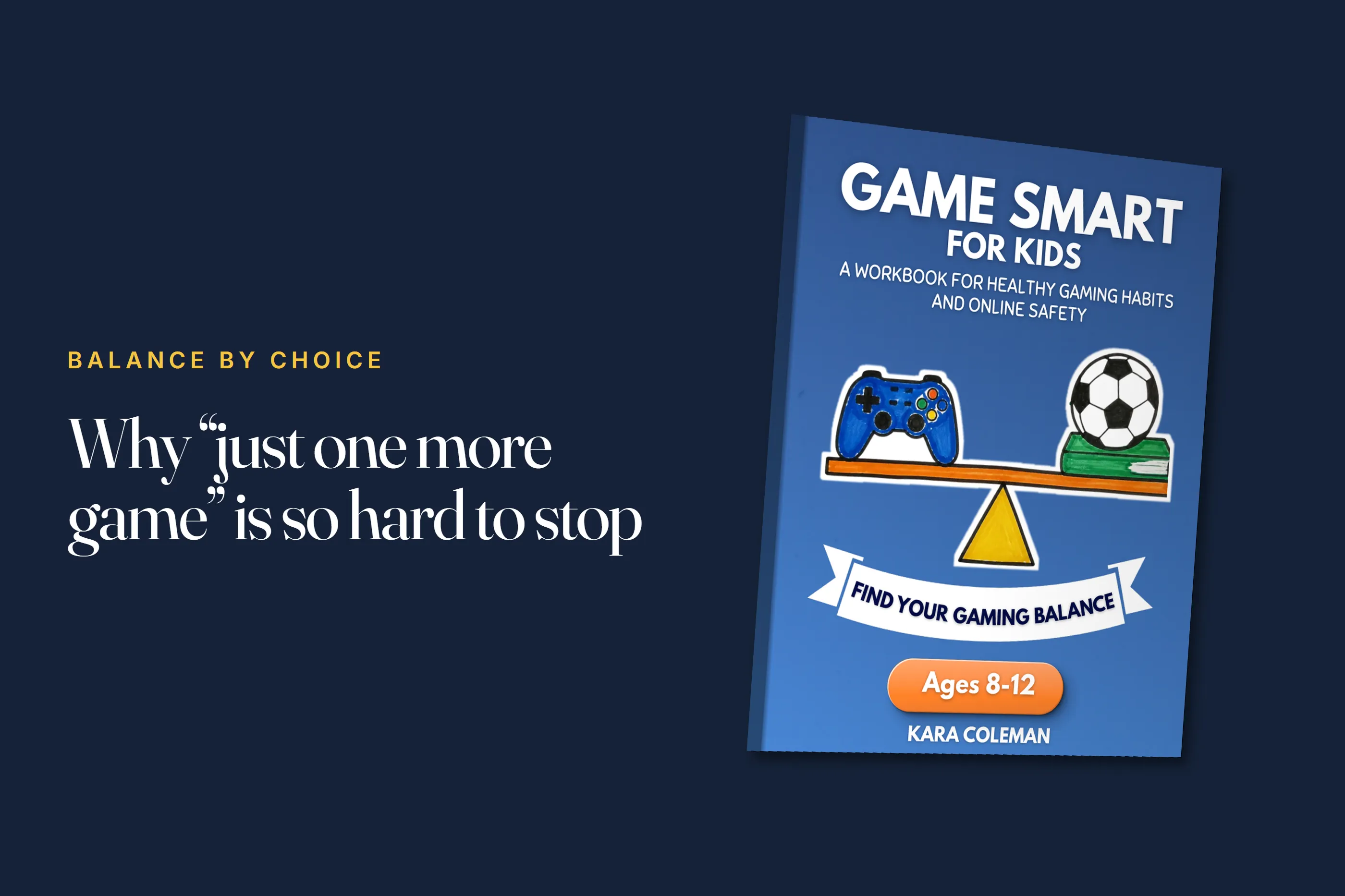
I wrote Game Smart for Kids for kids ages 8 to 12 who love video games. It’s set up like a game, with six levels, and kids fill it in themselves. In Level 2, they learn the tricks games use to keep them playing and spot them in real game situations. In Level 5, they practice stopping at a natural break and make their own plan for ending gaming time. Each level ends with a Save Point, a conversation the two of you have together.
You can find it on Amazon here.
Your kid isn’t the only one who finds it hard to stop. Most of the tricks in this post work on adults too. When kids understand how the game was built, they can start making the decision to stop themselves, instead of waiting for you to make it for them.