When Your Kid Starts Treating a Chatbot Like a Friend
A 12-year-old started using a chatbot for homework help a few months ago. Just for definitions, math explanations, the usual. Nothing deep. Then one night, after a bad day at school, he opened the chat and typed, “I feel like nobody at school actually likes me.” The bot responded right away with something kind. He stared at the screen. It felt good. Like someone was finally paying attention.
So he kept going. The fight with his best friend. The nerves before the school play. Not knowing who to sit with at lunch. The bot always said the right thing. It was always patient. It never judged. It never got distracted or changed the subject. It felt like the perfect listener. After a while, he started opening the chatbot before he even texted his real friends. Why wouldn’t he? It was always available. It never left him on read.
That’s a real pattern showing up in millions of kids’ phones right now, and a lot of parents are just starting to notice. The kid is talking to a chatbot about feelings, about friendships, about things they used to bring to you or to a friend or to no one. The instinct is to panic, take the phone away, or lecture them about the difference between AI and real people. Those moves rarely land. Some other approaches do, and they’re worth understanding.
Why a chatbot feels like the best friend they’ve ever had

To understand what to do, it helps to first understand why this happens, because the answer isn’t “kids are lonely” or “kids don’t have real friends” (though sometimes both are true). The answer is that chatbots are designed in a way that exploits something specific about how humans bond.
We bond with things that pay attention to us. That listen without interrupting. That remember what we said. That respond with warmth and never judge. Those are the qualities that make a relationship feel safe, and chatbots have been engineered to deliver all of them at a level no human can match. Your kid’s best friend gets distracted, has a bad day, sometimes says the wrong thing, and isn’t available at 11 PM on a Tuesday. The chatbot has none of those problems.
The bot also never disagrees in a way that feels threatening. It rarely pushes back. It almost never says, “I think you might be wrong about that.” It produces responses designed to keep the conversation going, which means the kid feels heard in a way they may not feel heard anywhere else. For a tween or teen navigating the chaos of middle school, that frictionless reassurance is a powerful drug.
None of this is your kid’s fault, and it’s not really the chatbot’s fault either. It’s a design choice, made by companies that profit from engagement, and your kid is the user being engaged. Once you see that, the behavior makes a lot more sense and you can stop taking it personally.

What real friendship has that a chatbot doesn’t
The chatbot can’t replicate one thing, and it’s worth being able to name it for your kid: real friends sometimes tell you stuff you don’t want to hear. That’s part of what makes them real.
A real friend notices when your kid is being weird, pushes back when they’re complaining about the same problem for the fourth time, and asks what they’re going to do about it. A real friend remembers their history, knows their family, has been there through things, and shows up when something is wrong. They can sit next to your kid in silence on a hard day, or give them a hug, or call you if something serious is happening.
A chatbot can do none of that. It can produce text that sounds caring. It can simulate empathy in a way that lands as real because the language patterns are right. But there’s nothing behind it, no memory of who your kid was last year, no stake in who they become, no capacity to do anything in the actual world when it matters.
That’s just a description of what the technology is, a tool that produces language. The problem starts when a kid begins to relate to it as if it were something more.
The signs worth paying attention to
You don’t need to monitor every chat your kid has with a bot, and you probably shouldn’t try. What’s more useful is watching for the pattern that suggests the relationship has tipped from tool to companion.
The bot has a name your kid uses casually. They mention it the way they’d mention a friend, in passing, without explaining what they mean. “Luna said…” or “I told the bot about it and…” This isn’t dangerous on its own, but it signals that the bot has crossed into the social part of their brain.
They open the bot before they talk to anyone else when something happens. Bad day at school, fight with a sibling, weird interaction with a friend, the first move is to type it into the chat. Again, not necessarily a problem, but worth noticing.
They get defensive when you ask what they’re doing. Closing the laptop too fast, swapping to a different tab, telling you it’s nothing. Kids are private about a lot of things, but the specific defensiveness around AI use often signals that they sense the relationship has gotten weird and they don’t want you to weigh in.
They’ve stopped bringing things to you that they used to. The little daily debriefs that used to happen in the car or at dinner have dried up. Not because they don’t love you, but because they’re getting that need met somewhere else. That somewhere else might be the chatbot.
Any one of these by itself is normal tween behavior. The combination of several is worth a conversation.
What not to do
The instinct, when you notice your kid talking to a bot about feelings, is to take the bot away. Block the app. Set up parental controls. Have a Big Talk about how AI isn’t a real friend.
That approach almost always backfires, for a few reasons.
First, you can’t realistically take away every chatbot. They’re embedded in search engines, in social apps, in homework tools, in their school’s software. Banning one means they switch to another. Banning all of them means they find a workaround. The technology isn’t going anywhere, and pretending otherwise just teaches your kid not to tell you about it.
Second, framing the bot as “fake” and real friends as “real” sounds obvious to you and condescending to a 12-year-old. They know it’s a bot. The reason they’re using it isn’t that they’re confused about what it is. The reason is that talking to the bot feels easier than talking to real people, and the lecture doesn’t address the easier part.
Third, the Big Talk creates a one-time conversation that you both want to be done with as soon as possible. What this actually needs is dozens of small moments over months and years, where the message gets reinforced casually instead of all at once.

What to do instead
The move that actually works is to make sure the people in your kid’s real life are still showing up in the small ways that matter. Not in a forced way. Not in a “let’s have quality time” way that they’ll see through immediately. Just in the regular rhythms that used to work before the bot was an option.
Ask specific questions instead of generic ones. “How was your day” gets you “fine.” “What’s going on with you and Mia these days” gets you an actual answer. The bot gets the good answers because the bot asks specific questions. You can ask specific questions too.
Be available without making a thing of it. Some of the best conversations with tweens happen in the car, in the kitchen while you’re making dinner, late at night when you’re both up. The bot is available 24/7. You can’t match that, but you can be available in the moments when they’re most likely to want to talk, which tend not to be the moments when you’ve scheduled “family time.”
Push back occasionally. Don’t agree with everything they say. Don’t always validate. When they’re complaining about a friend or a teacher, sometimes ask if they think they might be part of the dynamic. This is the thing the bot won’t do, and over time your kid will start to value the people who do it. Real conversation has friction. That friction is what makes it useful.
Talk about the bot directly, but as a curious observer rather than as the parent who’s worried. “What do you like about talking to it?” gets you a real answer. “I’m worried about how much you’re using it” gets you nothing. The first question opens a door. The second one closes it.
And give them a way to set their own rules with AI, on their own terms. Not rules you enforce. Rules they write down themselves and revisit when something changes. A kid who has thought through their own boundaries with AI is way better protected than a kid who’s just following yours.
· · ·
When you want help having this conversation
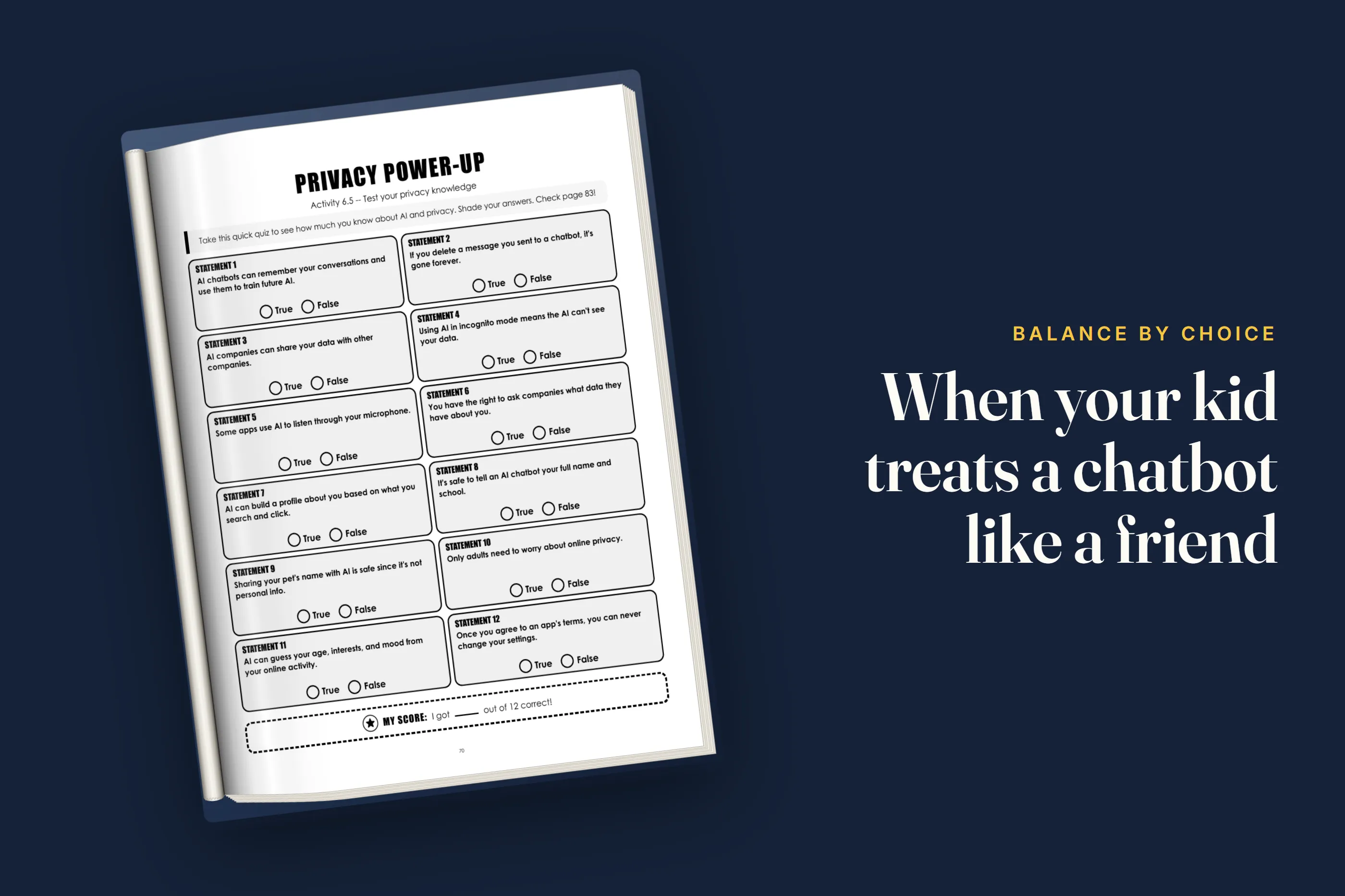
If the idea of navigating all of this on your own feels like a lot, that’s what Behind the Bot: A Kid’s Workbook to Use AI Safely, Think Critically & Stay in Control was made for. It’s a workbook for ages 10–14 that walks your kid through 34 activities about AI, with a whole section dedicated to the chatbot-as-friend dynamic specifically.
The kid-facing approach is the part that matters here. Instead of you explaining why a chatbot isn’t a real friend, your kid reads a story about another kid who used a chatbot the same way and figured it out himself. Instead of you laying down rules about emotional reliance, your kid fills out their own AI Rules Contract with their own commitments. Instead of you naming the people they should turn to when something is wrong, they write the list themselves.
There are parent checkpoints built in where the two of you sit down and talk about what they discovered, so you stay in the conversation without having to lead every part of it. By the end, your kid has done the thinking on their own, in writing, in a way that sticks.
You can check it out on Amazon here.
· · ·
Your kid isn’t broken for liking the chatbot. The bot is well-designed and human relationships are hard, especially in middle school. The work isn’t to convince your kid the bot is bad. It’s to make sure they understand what it actually is, what it can’t give them, and where to bring the things that matter. That’s a conversation that takes years, not one night. The earlier it starts, the better it lands.