Why Telling Kids to Get Off Their Screens Doesn’t Work (And What Does)
If you’ve ever said “get off your screen” approximately forty times in one evening and had it work exactly zero of those times, you’re not doing it wrong. You’re just using the wrong approach for this particular problem.
Rules and commands work great for things kids don’t particularly care about. Screens are different. Screens are designed by entire teams of engineers whose sole job is to make them impossible to put down. You’re not fighting your kid’s stubbornness when you tell them to stop. You’re fighting something that was literally engineered to resist exactly that.
The question worth asking isn’t how to get better at telling kids to stop. It’s how to get kids to actually want to stop — not because you said so, but because they get why it matters. That’s a completely different problem.
The Rule Problem
Here’s what happens with most screen time rules in most households. Parent sets a rule. Kid pushes back. Parent either holds firm and a battle ensues, or parent gives in and the rule quietly disappears. Either way, the kid hasn’t learned anything except that screens are worth fighting for.
The rule was imposed from the outside. The kid had no say in it, no understanding of why it exists, and no investment in following it. So they don’t.
This isn’t a parenting failure. Think about the last time you followed a rule you didn’t understand or didn’t agree to. Adults blow past those all the time — we’re just sneakier about it than kids are.
What Actually Works
Kids follow rules they helped make. Not because of some trick or psychological hack — but because when you have a say in something, you actually care whether it works.
It’s slower than just laying down the law. Some of the conversations will catch you off guard. But what comes out of it actually sticks — because it came from them, not from you.
Here’s what actually needs to happen:
First, kids need to understand their own patterns. And not in a “let me teach you a lesson” way — just genuinely curious. When did you use screens yesterday? What were you doing? How did you feel after? Most kids have never actually thought about this. They just reach for screens automatically, the same way adults mindlessly check their phones. But the moment a kid starts noticing their own habits — really noticing, not just being told about them — something starts to shift.

Second, kids need to understand why screens feel so hard to stop. This one tends to surprise kids. When a kid learns that apps and games are literally designed to keep them hooked — that it’s not weakness or bad behavior, it’s just how their brain responds to those reward loops — they stop feeling like they have a willpower problem and start feeling like they’re onto something. That shift is everything. You can’t fight something you don’t understand. Once they understand it, they actually want to.
Third, kids need to identify their own triggers. Boredom is the big one, but it’s not the only one. Some kids reach for screens when they’re stressed or anxious. Some do it out of habit — it’s just what happens after school or after dinner. Some do it because everyone around them is on screens and it feels weird not to be. You can’t work with something you haven’t named yet.
The moment a kid can say “I grab my tablet when I’m bored and don’t know what else to do” — that’s the moment something can actually change. You have something real to work with now.

What This Looks Like In Practice
This doesn’t have to be a formal sit-down conversation. It can start as simply as asking your kid at dinner: “What do you think you used screens for most today?” Not accusatory — just genuinely curious. See what they say.
From there you can start asking follow-up questions over time. Did you feel good after? Was it what you actually wanted to do or just what was there? What would you have done instead if screens weren’t an option?

You’re not running some long con to get them off their devices. You’re helping them build the habit of thinking about their choices rather than just making them on autopilot. That skill — pausing before reaching for a screen — is worth more than any rule you could set.
The goal isn’t a kid who follows your screen time rules while you’re watching. It’s a kid who gets why balance matters and starts making better choices when you’re not. Those are completely different things — and only one of them is still working when they’re fifteen.
Here’s what I noticed with my own kids once these conversations started happening. The battles didn’t disappear overnight. But the tone of them changed. Instead of “get off your screen” being met with eye rolls and negotiating, occasionally — not always, but occasionally — one of them would actually say “I know, I’ve been on too long.” That sentence. From a kid. Unprompted. That’s what awareness does. You’re not going to get that from a rule.
Want A More Structured Way To Do This?
Starting these conversations on your own is absolutely worth doing. But they tend to fizzle without some structure — you run out of questions, the kid loses interest, life gets busy.
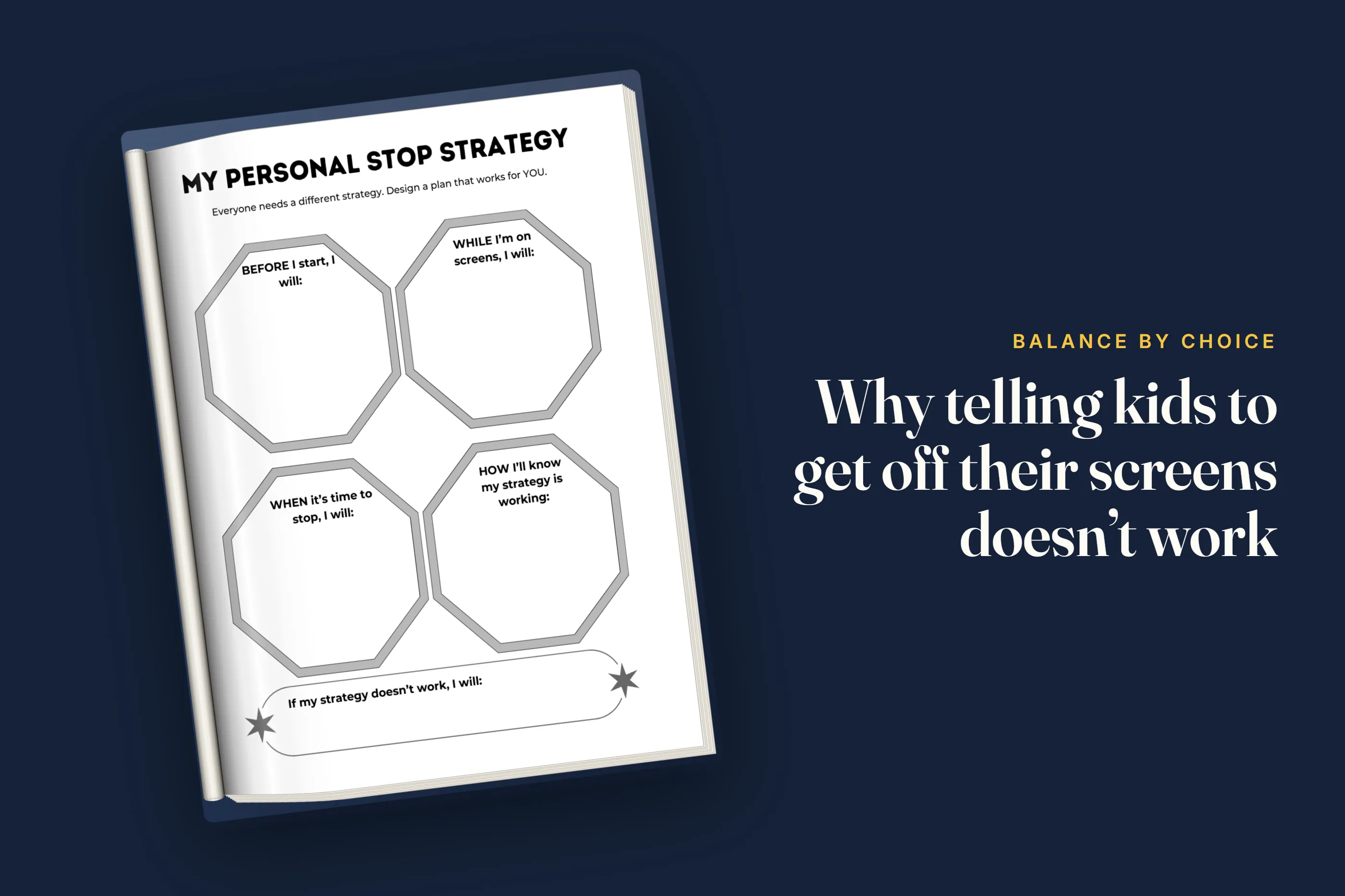
That’s the gap the Screen Smart for Kids Workbook was designed to fill. The first two sections walk kids through exactly this process — mapping their own screen time, understanding how screens affect them, identifying their personal triggers, and starting to build awareness about their own habits.
It’s not a lecture and it’s not a list of rules. Kids work through it themselves — at their own pace — and there are built-in conversation checkpoints so you stay in the loop without having to run the whole show.
If your kid is old enough to notice that screens feel hard to put down — and most of them are, even if they’d never say it — they’re old enough to start understanding why. And that’s where things actually start to change.
You can check out the full workbook on Amazon here.
The Bottom Line
Telling kids to get off their screens will always feel like pushing a boulder uphill. You’re not fighting laziness or attitude. You’re fighting the design of the thing itself.
The better move is helping kids understand what’s happening inside their own head when they’re on screens — and giving them the tools to manage it themselves.
Start with curiosity instead of commands. Ask more than you tell. It won’t happen in a week — but it does happen, and it’s a completely different feeling than winning an argument about screen time.