What to Do When Social Media Is Wrecking Your Tween’s Self-Esteem
You noticed it before she said anything. She started spending more time on her phone in the bathroom. Sometimes she’d look at herself in the mirror, then check something on her phone, then look back at the mirror. She stopped wearing the shirt she used to love. None of it was anything she’d articulated, and none of it was anything you could quite put your finger on either.
Or maybe it’s your son. He’s gotten quieter. He watches an hour of TikTok fitness content every evening. He’s started talking about abs and “looksmaxing” at thirteen.
This is not a tween rite of passage to shrug off. Social media is a constant stream of curated, filtered content aimed at a brain that is still figuring out who it is, and the research on tween mental health and body image is clear about what that does over time. For a lot of kids, it does real damage.
Banning social media is not a real option, and even if it were, it would end the conversation rather than help your tween navigate what they are going to use eventually anyway. By eleven, most kids have friends with accounts. By thirteen, a lot have their own. The goal is to help your tween see social media clearly, so that if they use it, they use it with their eyes open.
1. Have the filters-and-editing conversation (and keep having it)

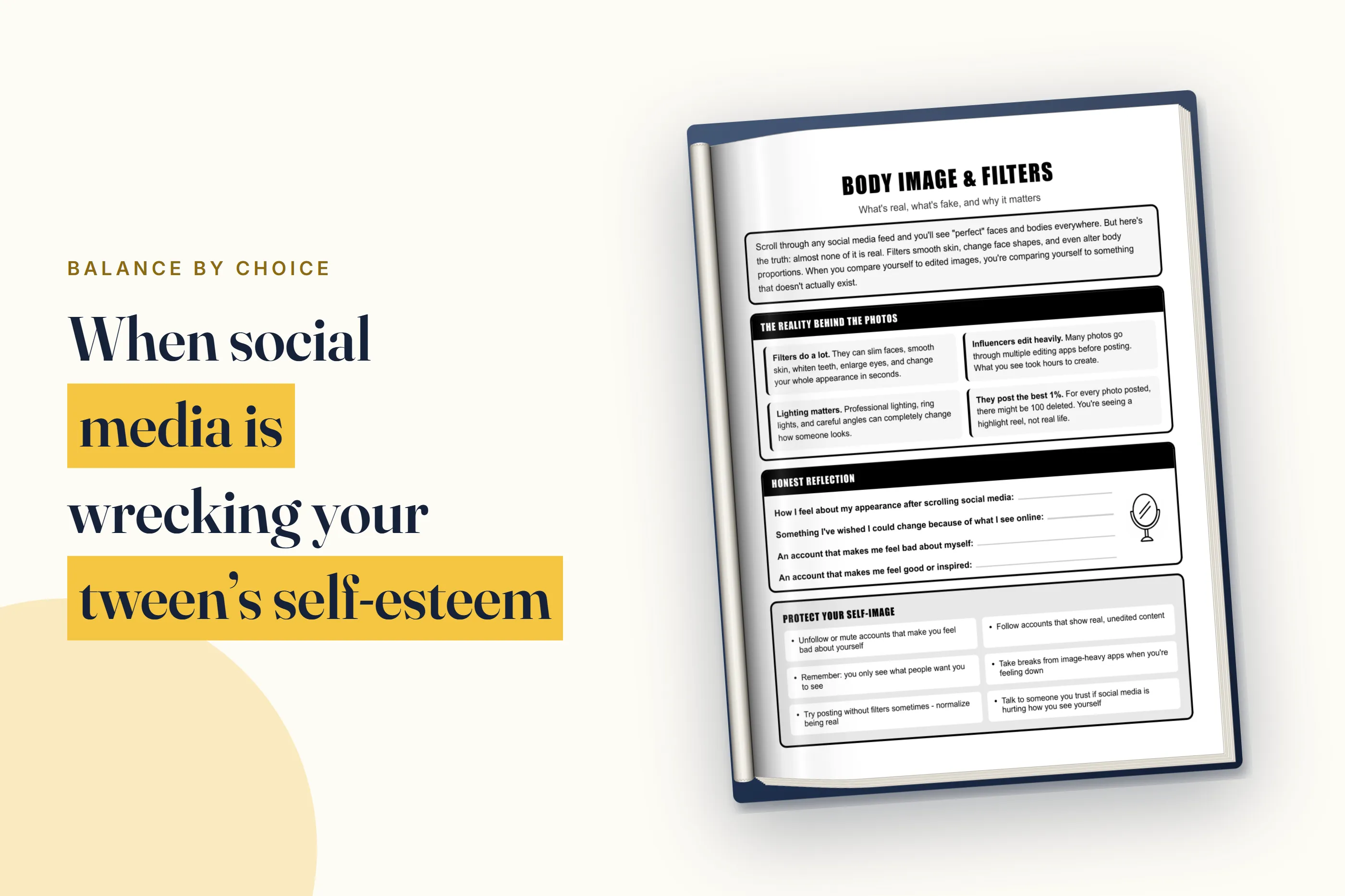
Your tween knows filters exist. What they often don’t fully grasp is how pervasive and invisible the editing is. Almost every influencer they follow, every “pretty girl from school” with the great posts, every fitness TikTok has been edited in some way: skin smoothed, waist narrowed, jaw sharpened. Sometimes the person does it themselves. Sometimes the app does it automatically. Sometimes a professional photographer is involved, with hours of Photoshop work.
This conversation needs to happen over and over, not once, and it lands better when you are actually looking at content together. “Oh look at that, see how her skin has zero pores? That’s a smoothing filter. That is not what skin looks like. Nobody’s skin looks like that.”
You are not trying to make them cynical. You are trying to build a reflex: every time they see a “perfect” image, some part of their brain should ask, what’s been edited here? Without that reflex, they are comparing their actual Tuesday-morning face to a professionally engineered illusion, and then wondering what is wrong with themselves.

2. Curate their feeds together (who they follow matters more than how long they’re on)
Screen time limits treat all minutes as equal, but they are not equal. An hour following friends, sports teams, and creators who make them laugh is a completely different experience from an hour following thirst traps and unattainable body content.
Sit down with your tween, with no agenda to judge, and just look through what they follow. Who do they follow? Why? How do they feel after seeing that person’s posts? If the answer to the last question is something like “kind of bad about myself,” that is worth taking seriously.
You are not trying to force an unfollow. You are trying to help them notice the pattern. Once a tween actually registers “I feel worse every time she posts,” they usually start culling the feed on their own. The unfollow becomes an act of self-respect when they are the one making it.
3. Name comparison when you see it happening
When your tween says “I wish I had her hair” or “he’s so much more ripped than me,” try not to jump straight to reassurance. A quick “you’re beautiful just the way you are” feels loving, but it usually shuts the conversation down.
Instead, name what is happening. “That’s comparison. You’re looking at one photo of one person on one day and comparing it to how you feel about yourself all the time. That is not a fair fight.”
Giving comparison a name, turning it into a thing instead of a vague feeling, helps your tween start recognizing it on their own. Over time they start catching themselves: “Oh. I’m doing the comparison thing again.” That sentence, said to themselves in the middle of a scroll, is more protective than any rule you could set.
4. Shift the “why” of posting
Ask your tween, honestly: when you post something, what are you hoping happens?
If the answer is “I want to see how many likes I get,” that is worth talking about further, with curiosity rather than judgment. What does it feel like when a post does well? What does it feel like when one does not? Is the version of yourself you are showing online the version you actually are?
You are not trying to make them quit. You are trying to help them post from a place of “this is me” instead of “will people like this version of me.” The difference between those two positions shows up everywhere later, in their mental health and in the kind of person they turn out to be.

5. Build offline identity so online stops feeling like everything
The tweens who weather social media the best are the ones whose identity is rooted somewhere besides the phone.
A kid who is deeply into soccer, or drawing, or their church youth group, or a tight friend group that does things together already has multiple places where they know who they are. Social media becomes one input among many. A kid whose only real social life is their phone has much less to weigh against what they see on it.
This is the quietest of the five ideas, and also the one that matters most over the long term. Every hour your tween spends invested in something offline is an hour their sense of self is being built by something other than an algorithm.
· · ·
When your tween is ready to think about this themselves
These are the conversations to have. But a lot of parents I talk to run into the same problem. The conversations go okay in the moment, and then nothing really changes. The patterns stay the same.
A conversation from a parent is not the same thing as a realization your tween comes to themselves, and for this topic, the second one is what moves the needle. That is a big part of why I created Own Your Screen Time, a workbook for kids ages 11 to 14 to walk through this process on their own terms.
There is an entire section called Social Media & Online Identity that addresses exactly what this post is about. It opens with a story about posting pressure, written from a tween’s perspective. There is an activity on filters and editing that lets them see how the manipulation actually works. There are reflection prompts on body image and comparison that get them thinking about their own feed, without a parent telling them what to think. “A Letter to Future Self” and a “6-Panel Comic Strip” help them process what they are actually experiencing.
Because the whole workbook is written for teens, with real teen interviews rather than parent lectures, kids actually read it. The two parent check-ins built in give you structured moments to talk about what they are noticing, without the conversation turning into an interrogation.
You can check it out on Amazon here.
You are not trying to raise a tween who quits social media. You are trying to raise one who can use it without being used by it. A kid who sees the filters for what they are, who catches themselves comparing and stops, who posts as themselves instead of as a version engineered for likes.
Nobody at the platforms is working on any of that. If your tween learns to do it, they will have learned it from you.