How to Help Your Child Set Their Own Screen Time Goals — And Actually Stick to Them
Most screen time conversations in most households go one of two directions. Either the parent sets the rules and the kid resists them, or the parent gives up trying to set rules at all and everyone just hopes for the best. Neither one feels great, and neither one actually solves anything long term.
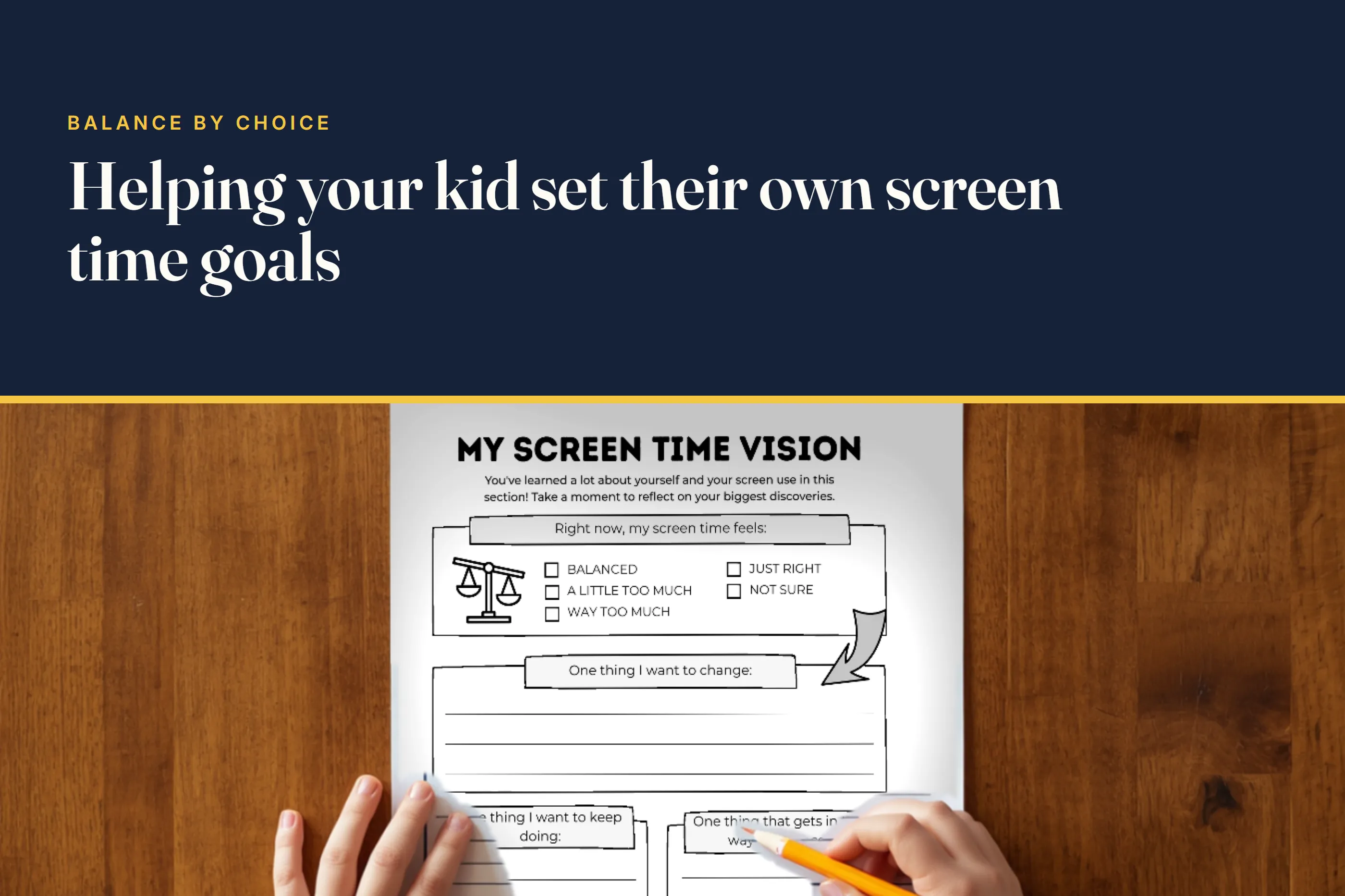
There’s a third option that most parents don’t think to try: letting the kid set the goals themselves.
Not in an “anything goes” way. You’re still the parent and the boundaries still exist. But there’s a real difference between a kid who’s been told they get one hour of screens after homework and a kid who sat down, thought it through, and wrote down what they actually want their screen time to look like.
One of them is just waiting for you to look away. The other one actually has somewhere to land.
Why Kids Don’t Stick to Screen Time Limits
When a limit comes from the outside, kids follow it when you’re watching and drop it the moment you’re not. That’s not defiance — that’s just what happens when you hand someone a rule they had no part in making.
The other problem is that most screen time limits are purely about restriction. No screens before homework. No screens after 8pm. No more than an hour. These rules tell kids what they can’t do but give them no framework for thinking about what they actually want. A kid who has never thought about whether their screen time feels balanced has no internal compass — just a set of external rules to push against.
Goal setting flips this. Instead of starting with what’s not allowed, you start with what they actually want for themselves. It sounds like a small shift but the conversation that comes out of it is completely different — and so are the results.
Before a child can set a meaningful goal, they need some self-awareness about where they currently are. This sounds obvious but most kids have genuinely never thought about their screen time. They just do it.
Ask what they think they use screens for most. Ask if there’s anything screens crowd out that they wish they had more time for. Ask how they usually feel after a long screen session. Simple questions, no agenda — just curiosity.
You’re not fishing for a particular answer. You’re just helping them notice something they’ve almost certainly never thought about — because nobody has ever asked them to.

This is where most parents want to jump in and steer. Resist that urge.
Ask your child: if you could change one thing about how you use screens, what would it be? You might be surprised by the answer. Kids often already know something feels off — they just haven’t been asked to name it. Maybe they wish they didn’t feel so grumpy when screens go off. Maybe they wish they had more time for something else. Maybe they genuinely feel like their screen time is fine and they don’t want to change anything.
All of those are somewhere to start. Even “I don’t want to change anything” is useful — it just means you’re not quite there yet and the conversation needs to go a little deeper.
Whatever they land on has to feel like it came from them. A goal you suggested that they half-heartedly agreed to is just a rule in disguise — and it’ll last about as long as rules do.

Vague goals don’t work for kids any more than they work for adults. “Use screens less” is not a goal. “Stop using my tablet after 8pm on school nights” is a goal. The more specific the better — it needs to be clear enough that the child can tell at the end of the day whether they did it or not.
This is also where you can offer guidance without taking over. If your child says their goal is to “be better about screens” you can ask follow-up questions: better how? Starting when? How will you know if it’s working? You’re helping them sharpen the goal, not replacing it with your own.
If a kid can answer what they’re changing, when they’re starting, and how they’ll know if it’s working — that’s a goal worth writing down.
Every goal hits resistance. The best time to talk about that is before it happens, not during.
Ask your child: what do you think is going to make this hard? When do you think you’ll most want to give up? What will you do when that happens?
This isn’t being negative about it — it’s just being honest. A kid who has already thought through the hard moments is much better at getting through them when they actually arrive. And they will arrive — not because the goal is wrong, but because that’s just what changing a habit feels like. Every time.

Checking up and checking in sound similar but they land completely differently. Checking up feels like surveillance — suddenly the goal is something happening to them again rather than something they chose. Checking in feels like you’re on their side. Same information, completely different dynamic.
A simple “how’s your goal going this week?” at a natural moment — dinner, a car ride, bedtime — is enough. You’re not conducting a progress report. You’re just keeping the conversation alive and giving them a chance to problem solve out loud if something isn’t working.
If they’ve slipped up, the response that keeps them going is curiosity, not disappointment. What made it hard? What would help next time? One bad week doesn’t mean the goal is wrong — it might just mean the goal needs adjusting.
The Bigger Picture
Teaching a child to set and work toward their own screen time goals isn’t really about screen time. It’s about teaching them to notice their own habits, identify what they want to change, make a plan, and follow through on it. Those are skills that show up everywhere — in school, in friendships, eventually at work.
Screen time is just a particularly good place to practice because it’s immediate, tangible, and something they actually care about. A kid who figures out how to manage their own screen time has learned something that has nothing to do with tablets.
I’ll be honest — this process isn’t fast and it isn’t always smooth. There were conversations with my kids that went nowhere, goals that lasted three days, and weeks where everything we’d worked on seemed to disappear. But there were also moments that genuinely surprised me. One of my kids came to me and asked if we could adjust her screen time goal because she’d realized it wasn’t working the way she’d hoped. She wanted to change it herself. That’s not something that happens with a rule you handed down. That only happens when the goal was theirs to begin with.
Want A Structured Way to Work Through This Together?
These five steps look clean on paper. In real life they’re messier — kids get distracted, goals need adjusting, and some conversations just don’t go anywhere. That’s normal.
That’s the gap the Screen Smart for Kids Workbook was designed to fill. It walks kids through this entire process in a structured way — from reflecting on current habits all the way through setting specific goals, planning for obstacles, and building routines that support those goals. It’s designed to be worked through independently by kids ages 8–10, with five built-in checkpoint conversations so parents stay involved without having to drive the whole thing.
The goal was never compliance. It’s a kid who actually understands their own relationship with screens and has something real to work with — with you alongside them, not just enforcing rules at them.
You can check out the full workbook on Amazon here.
The Bottom Line
Kids don’t stick to screen time limits because limits imposed from the outside give them nothing to hold onto when no one is watching. Goals they set themselves give them something different — a standard they chose, which is the only kind that travels with them.
Start the conversation. Ask more than you tell. And be ready to be surprised — most kids already know something feels off. They’ve just never been asked.